 GeoPrime Energy · Deep Dive
HG-250 Technical Architecture
A 250 kW hydrogen-ready modular solid oxide power platform built around replaceable stack cartridges, an owned balance-of-plant, and a layered intelligence stack. All parameters shown are Generation 1 design targets for a development-stage system.
System Architecture
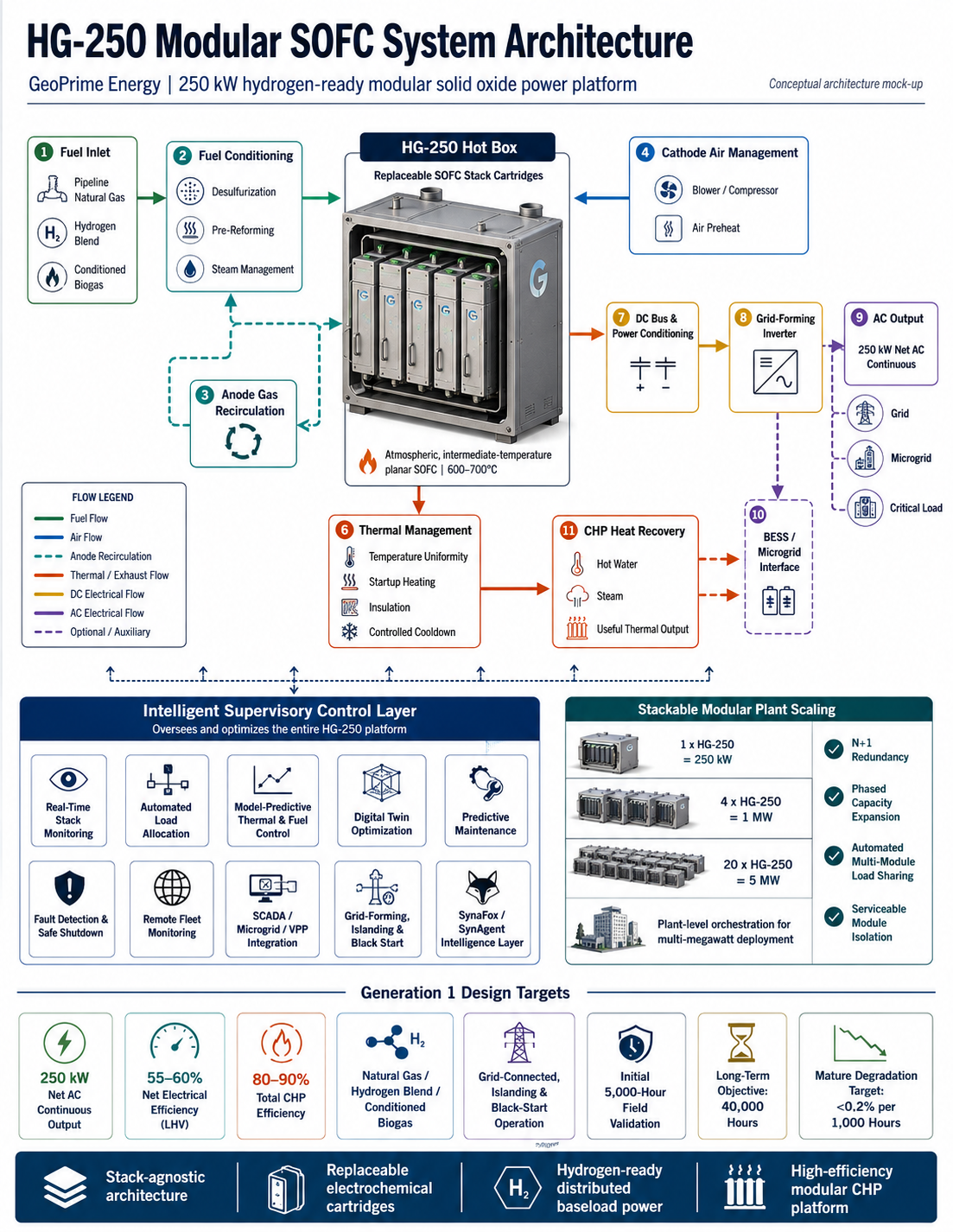
Power & Process Flow
Fuel Path
Pipeline natural gas, hydrogen blends, or conditioned biogas enter fuel conditioning, desulfurization, pre-reforming, and steam management, with anode-gas recirculation improving fuel utilization and system efficiency.
Hot Box & Air Management
Cathode air is blown and preheated into the hot box, which houses replaceable SOFC stack cartridges operating as an atmospheric, intermediate-temperature planar system at roughly 600-700°C (Gen 1 target).
Thermal Management
Temperature uniformity control, startup heating, insulation, and controlled cooldown protect stack life and enable safe cycling.
Power Conversion
DC bus and power conditioning feed a grid-forming inverter delivering 250 kW net AC continuous (Gen 1 target) to grid, microgrid, or critical-load connections.
BESS / Microgrid Interface
Optional battery energy storage and microgrid interfaces support islanding, black start, and dynamic load balancing within hybrid campuses.
CHP Heat Recovery
Hot water, steam, and useful thermal output raise total CHP efficiency toward the 80-90% Generation 1 target for industrial and commercial thermal loads.
Replaceable Stack Cartridges & Stack-Agnostic Design
The HG-250 packages third-party electrochemical stacks as replaceable cartridges with standardized mechanical, thermal, and electrical interfaces. Generation 1 deliberately avoids proprietary cell-chemistry development: qualified suppliers (e.g., Elcogen- or Ceres-class stacks) provide the electrochemical core, while GeoPrime's engineering focus, and IP value, sits in system integration, packaging, controls, and thermal management.
Supply-chain resilience
The platform can accommodate multiple qualified stack candidates, reducing single-supplier dependency and enabling future stack upgrades without core redesign.
Serviceability
Field-replaceable cartridges allow targeted swap-out of degraded stacks, minimizing downtime and extending balance-of-plant life across the 40,000-hour long-term durability objective.
Layered Intelligence Stack
Local System Control
Real-time sensor processing, safety-critical interlocks, thermal management loops, and power conversion control at the module level.
Plant Orchestration
Multi-module coordination, load-following logic, grid-interface management, and fuel/CHP optimization across a campus.
Fleet Management
Remote performance monitoring, digital-twin simulation, predictive maintenance, and over-the-air updates across the deployed fleet.
Degradation modeling · anomaly detection · efficiency optimization · thermal stress analysis · dynamic load forecasting · component health scoring, an owned intelligence layer that compounds in value as the fleet scales.
Modular Plant Scaling
Plant-level orchestration supports multi-megawatt deployment with phased capacity expansion, automated multi-module load sharing, and serviceable module isolation, scaling from a single module to multi-MW plants without core redesign.